
Winning Perfumery Catalogue for Online Retail: A B2B Guide
Veröffentlicht von nunu on 30.10.26
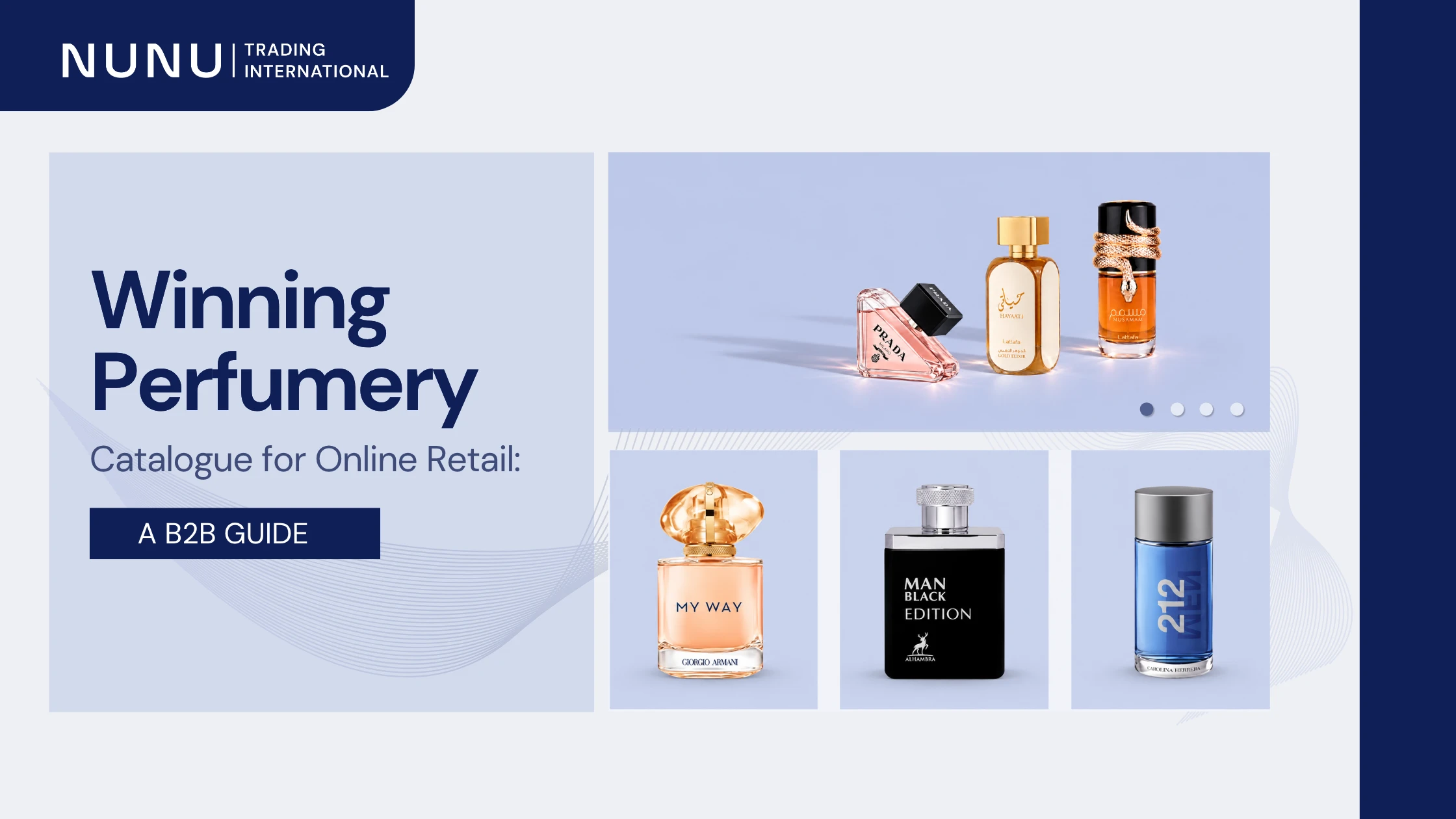
The difference between a perfumery catalogue that converts and one that simply takes up shelf space online is not the number of products — it is the logic behind the selection. Most buyers who are new to fragrance e-commerce make the same mistake: they try to list everything available from their wholesale supplier and wait for results. The problem is that an undifferentiated catalogue does not give the consumer a reason to buy from you specifically.
A winning online fragrance catalogue is curated, structured, and commercially balanced. It combines references that drive traffic with references that drive margin, covers the consumer profiles your channel actually reaches, and is sized to stay manageable from an inventory and listing operations perspective. This guide explains the principles behind catalogue construction in perfumery — and how to apply them using a wholesale stock offer as your starting point.
What Makes a Perfumery Catalogue Convert Online
Before building your selection, it helps to understand the conversion context you are working in. According to Optimonk's 2026 Industry Conversion Rate Benchmarks, the beauty and personal care category achieves some of the highest conversion rates in e-commerce — between 3.46% and 6.8% in its industry benchmarks — driven by lower price sensitivity and strong repurchase behaviour. That is the opportunity. The risk is on the other side: the broader beauty category reports a cart abandonment rate of 72.04%, according to Freeyourself.com's Perfume Cart Abandonment analysis.
The factors that most consistently separate a converting catalogue from one that generates sessions without sales are: clarity of selection, recognisable brand names balanced with discovery references, the right concentration and format for the price point, and product data complete enough to reduce the buyer's decision uncertainty. Cart abandonment in fragrance is almost always a trust or clarity problem, not a price problem.
A catalogue that converts online typically shares four structural characteristics:
- Anchor references: two or three well-known brand names that give the catalogue credibility and drive organic search traffic
- Margin drivers: niche, Arabic, or high-concentration references with lower price sensitivity and higher per-unit margin
- Discovery references: newer or less-distributed fragrances that give the store a reason to be followed and revisited
- Format diversity: multiple size and concentration options per reference — EDP, Parfum, travel formats — to serve different purchase occasions and price points
The Ideal Mix: Niche, Mass Market, Genderless, and High Concentration
No single reference type builds a winning catalogue on its own. The goal is a mix that balances traffic, margin, and breadth of consumer appeal — calibrated to the channel and consumer profile you serve.
| Segment | Recommended Mix | Role in the Catalogue | What to Prioritise |
|---|---|---|---|
| Designer / Mass Market | 20–30% | Traffic anchor — drives search and brand recognition | Best-known references in the most-searched sizes (100ml EDP) |
| Premium / Parallel | 25–30% | Volume + margin balance — strong sell-through | Mid-price references with broad appeal across genders |
| Niche Fragrance | 25–30% | Margin driver — lower price sensitivity, higher loyalty | Oud, oriental, floral niche — refer to current trend data |
| Genderless / Unisex | 10–15% | Breadth — reaches younger consumers, broader SKU reach | Wider appeal per listing; strong on Zalando and lifestyle e-commerce |
| High Concentration (Parfum / Extrait) | 10–15% | Gifting + premium positioning | Formats between EUR 60–150 RRP; strong Q4 and gifting performance |
Mix ratios are indicative starting points. Adjust based on your channel (FBA, own store, Zalando) and the consumer profile you reach.
For a deeper view of which niche segments are generating the strongest demand right now, our Niche Perfume Trends guide covers the five subcategories with the best margin-to-demand profile for wholesale buyers in Europe.
How Many References to Work by Category
Catalogue size has a direct relationship with conversion — but not the one most buyers assume. Eightx's analysis of SKU counts across Shopify brands by revenue band highlights FIGS as a specific example: 17 core scrubwear styles in 10 core colours — 170 combinations before sizing — generated more than 60% of its FY2025 net revenue. This is an apparel example, rather than a fragrance benchmark or proof that smaller catalogues always outperform larger ones. For fragrance buyers, the practical takeaway is to focus inventory, ad spend, and management attention on references with demonstrated demand; the 50–120 active SKU range below is an indicative planning framework, not a performance guarantee.
Beyond 100 SKUs, Kolonell's 2026 Catalogue Structure for Conversion report notes that internal search becomes the top conversion lever — with autocomplete delivering up to +30% more product pages viewed. Below that threshold, strong category navigation and curated collections carry the load.
| Category / Channel | Recommended SKU Range | Selection Guide |
|---|---|---|
| Amazon FBA (launch phase) | 15–30 active SKUs | Start focused: 3–5 references per segment, 2–3 sizes each. Test sell-through before expanding. |
| Amazon FBA (scaled) | 50–100 active SKUs | Add references based on data: reorder winners, delist slow-movers after 60 days. |
| Own e-commerce store | 40–80 active SKUs | Curate for your audience; discovery references earn loyalty; anchor references earn traffic. |
| Multi-marketplace | 80–120 active SKUs | Segment by platform: niche and premium on Zalando; high-volume mass-market on Amazon. |
| Physical + online hybrid | 30–60 active SKUs | Prioritise overlap: references that perform in-store tend to convert well online with good product data. |
Source: Eightx SKU benchmarks by revenue band, 2026; Kolonell Catalogue Structure for Conversion, 2026.
Related reading: Low MOQ Wholesale Beauty: Flexible Minimums That Win — Nunu Trading Blog
How a EUR 300 minimum order lets you test new catalogue references at low volume before scaling — the most effective way to build a high-conversion catalogue without overstock risk.
How to Use the Stock Offer to Build Your Selection
The Nunu Trading Stock Offer — a daily-updated Excel file with EAN codes, confirmed quantities, and wholesale pricing across perfumery, skincare, makeup, and haircare — is the practical starting point for building a curated catalogue. Here is a step-by-step method for turning a wholesale stock file into a structured, conversion-ready selection:
Step 1 — Filter by Category and Segment
Sort the stock file by category (perfumery) and then by brand tier. Identify which designer anchors, premium references, and niche references are currently available in confirmed stock. Availability is your first filter: a reference you cannot reliably replenish within 48–72 hours is a listing risk, not a catalogue asset.
Step 2 — Apply the Mix Ratios
Using the mix framework above, allocate your target SKU count across segments. If you are launching a 30-SKU FBA catalogue, that means approximately 8 designer references, 8 premium, 8 niche, and 6 split between genderless and high-concentration formats. Select the specific references from the stock file that fit each allocation.
Step 3 — Prioritise EAN Availability
Every reference in your catalogue needs a valid EAN for marketplace listing. The Nunu Trading stock file includes EAN codes per reference — use them to cross-check against your marketplace's product database before finalising your selection. References without valid EANs require additional setup time and may not be eligible for listing on all platforms.
Step 4 — Check Stock Depth Before Listing
Before publishing a listing, confirm that the available quantity in the stock file supports your planned listing period. For FBA, factor in your replenishment lead time: 24–48 hours in Spain, 48–72 hours across the EU. For own-store or marketplace listings, set a reorder point that triggers before stockout, not after.
Step 5 — Start Small, Scale on Data
Launch with your curated selection, track sell-through by reference within the first 30 days, and use that data to guide your next order. The EUR 300 minimum order on Nunu Trading means you can introduce new references at minimal financial risk — which is precisely how a winning catalogue is built: iteratively, reference by reference, guided by real conversion data rather than catalogue speculation.
The Catalogue Is Only as Good as the Supply Behind It
A curated selection loses its conversion advantage the moment a reference goes out of stock mid-listing. For online retailers and FBA sellers, a stockout means a suppressed listing, lost ranking, and a competitor gaining the visibility you built. The supply chain behind your catalogue is not a back-office concern — it is a front-end conversion variable.
Nunu Trading's daily-updated stock file gives you the real-time inventory visibility to keep your catalogue stocked, your listings active, and your sell-through data clean. With a EUR 300 minimum order, authenticated products, EU-compliant invoicing, and dispatch within 24–48 hours in Spain and 48–72 hours across the EU, the platform is designed to support exactly the kind of lean, data-driven catalogue strategy described in this guide.
Download the Stock Offer and Start Building Your Catalogue
Register as a B2B buyer on Nunu Trading and download today's stock file — with EAN codes, confirmed quantities, and wholesale pricing across perfumery, skincare, makeup, and haircare.
Published by Nunu Trading | Wholesale Perfumery & Cosmetics Distributor — Europe. www.nunutrading.com